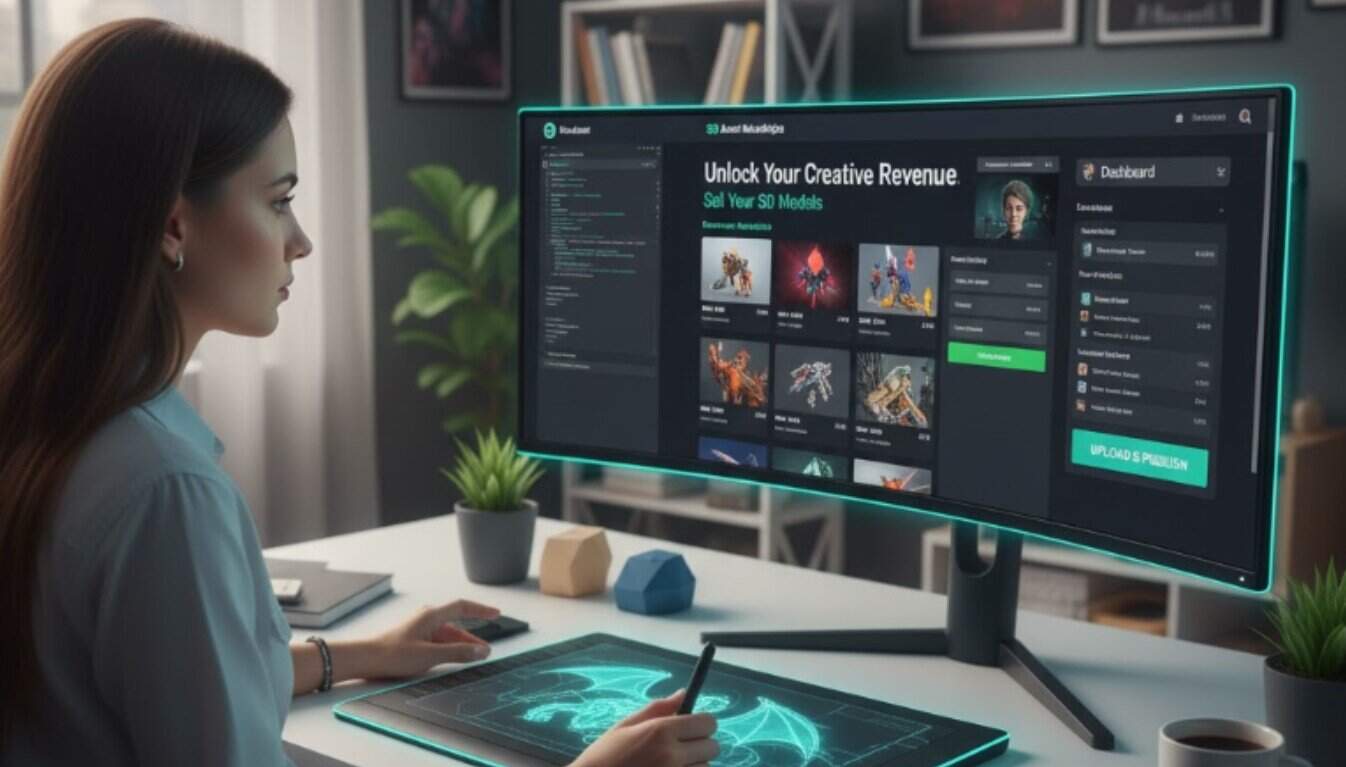
Start your 3D model selling journey today with 3d export and reach millions of potential buyers worldwide.
The Thriving Market for 3D Models
The demand for quality 3D models has never been higher. From video game studios seeking game-ready assets to architects visualizing buildings, from e-commerce companies displaying products to VR/AR developers creating immersive worlds, industries across the globe are hungry for professional digital models. What was once a niche skill has become a legitimate career path, with successful 3D artists earning substantial income from their creations. The global market isn’t slowing down—it’s accelerating, and if you have the skills to create quality 3D models, there’s a ready audience waiting to buy them.
This comprehensive guide will walk you through everything you need to know to start selling your 3D models professionally in 2025, from understanding the market to choosing the right platform to optimizing your listings for maximum sales.
Understanding What Sells in 2025
Before diving into the mechanics of selling, it’s crucial to understand which types of 3D models consistently perform well in the marketplace. This knowledge shapes your creative decisions and helps you focus your efforts where demand is highest.
Game-ready characters and creatures remain consistently popular. The gaming industry invests heavily in diverse character assets, from realistic humanoid models to fantastical creatures. These models need to be optimized for specific game engines like Unity or Unreal, making technical accuracy essential. Environments and props follow closely behind—game developers need everything from architectural interiors to vegetation, weapons, and decorative objects.
Architectural and real estate visualization models command premium prices. Architects, real estate professionals, and interior designers use high-quality 3D models to present concepts to clients and investors. These models typically require exceptional detail and accuracy, but buyers are willing to pay accordingly. Furniture, vehicles, and product design models also fall into this lucrative category.
Animation and film production assets are in constant demand. Studios need rigged characters, complex environments, and specialized props. The quality bar is high, but so are the potential earnings. VR and AR models represent a growing segment—as these technologies expand, the demand for optimized assets continues to increase. STL files for 3D printing have created an entirely new market, from miniatures for tabletop gaming to functional household items and cosplay props.
The common thread connecting all best-sellers is quality. Whether your specialty is photorealistic models, stylized characters, or functional prints, buyers expect your work to meet professional standards. Models that are well-optimized, properly textured, correctly scaled, and free of technical issues consistently outperform amateur work.
The Top Platforms for Selling 3D Models
With numerous marketplaces available, choosing where to list your work is one of the most important decisions you’ll make. Each platform serves different audiences, offers different commission structures, and has unique strengths. Many successful creators sell on multiple platforms simultaneously.
TurboSquid has dominated the 3D model marketplace since 2000 and remains one of the largest platforms. Trusted by professionals in film, gaming, advertising, and architectural visualization, TurboSquid attracts serious buyers willing to invest in quality. The platform is particularly strong for high-poly, detailed models and professional-grade assets. Commission rates are competitive, and the platform provides tools to optimize your models for different applications. The downside is that TurboSquid has strict quality standards—your models must meet their specifications to be accepted.
CGTrader emerged in 2011 with a mission to be designer-friendly, and it’s maintained that philosophy. The platform now hosts millions of creators and offers some of the highest commission rates in the industry—earning up to 80% royalties from each sale. CGTrader also offers freelance job opportunities alongside marketplace sales, allowing you to build long-term client relationships. The interface is intuitive, and creators appreciate the platform’s analytics and insights that help optimize portfolios.
Sketchfab specializes in interactive 3D previews, making it easier for buyers to inspect exactly what they’re purchasing before committing. This transparency often leads to higher buyer confidence and more sales. The platform maintains a community of around five million members, providing exposure to a substantial audience. However, competition is intense, and standing out requires exceptional work and smart marketing.
3DExport is a dedicated marketplace specifically designed for 3D model sellers and buyers. With a global community of creators and a focus on quality assets, 3DExport provides an intuitive platform with competitive commission rates and excellent seller support. The marketplace caters to diverse model types—from game assets to architectural visualizations to 3D printable files. 3DExport stands out for its creator-friendly interface, detailed analytics, and strong emphasis on helping sellers optimize their listings and reach the right audience. The platform’s sophisticated search and filtering system makes it easy for buyers to discover exactly what they need, translating to better visibility for your models.
Fab (Epic Games’ unified marketplace) recently combined the Unreal Engine Marketplace, Sketchfab, ArtStation Marketplace, and Quixel into one platform. Fab offers an 88% revenue share for sellers (100% during promotional periods) and provides a next-gen real-time 3D viewer that lets buyers inspect models in incredible detail. The platform supports multiple creation tools including Blender and Maya, making it accessible to a wide range of artists. This consolidation represents a significant shift in the 3D marketplace landscape.
Blender Market (rebranded as Superhive) focuses exclusively on Blender users and Blender-compatible content. If your target audience is Blender creators, this platform offers excellent visibility and community engagement. The platform features a creator-first model, and during certain periods, you can retain 100% of earnings.
Etsy deserves mention despite not being a dedicated 3D platform. For 3D printing enthusiasts selling STL files and printable models, Etsy provides access to millions of potential customers. The platform excels for niche markets like miniatures, cosplay props, personalized items, and home décor designs.
Renderosity serves the digital art community with nearly 800,000 members. Established in 1998, it’s evolved into a comprehensive marketplace supporting 2D and 3D creations, with particular strength in character assets and rendering work. The platform offers competitive rates, free advertising options, and an engaged community of creators.
Preparing Your Models for Sale: Quality and Optimization
Creating a great 3D model is only half the battle—preparing it correctly for sale is equally important. Buyers expect models to meet specific technical requirements, and models that fall short will face returns, negative reviews, and poor sales.
Start with geometry optimization. Your model’s polygon count should match its intended application. Game-ready assets need to be low-poly for performance, while architectural visualization or film models can be high-poly for detail. Ensure your geometry is clean—no duplicate vertices, non-manifold edges, or hidden geometry that will confuse buyers or cause problems in their projects. Test your models in the target software before listing them.
Texturing and materials matter significantly. Provide complete texture maps (diffuse, normal, metallic, roughness, etc.) in standard formats. Include texture files organized logically. If your model uses advanced materials or shaders, document them clearly. Some buyers will use your models on different rendering engines, so ensure compatibility where possible.
Scale and units must be accurate. Nothing frustrates buyers more than importing a model and discovering it’s the wrong size. Clearly specify your model’s dimensions and the unit system used. Many platforms require models to be at a specific scale, so verify this during preparation.
Rigging and animation readiness apply to character models. If you’re selling animated characters, ensure your rigging is clean and functional. Test animations in the target engine. Provide clear documentation of what’s included—skeleton structure, blend shapes, animation cycles, and any custom setups.
File format variety increases your model’s appeal. Provide models in multiple formats when possible—OBJ, FBX, BLEND, USD, STL, or others depending on your platform. Different creators use different software, and flexibility in formats expands your potential market.

Creating Compelling Listings That Convert
Even exceptional models won’t sell if no one can find them or if your listing fails to communicate their value. Creating compelling product listings is an art that combines clear communication, professional presentation, and smart marketing.
Start with an engaging title. Use specificity rather than vagueness. Instead of “Chair,” write “Modern Minimalist Office Chair with Adjustable Height—Game Ready.” Titles that include key search terms help buyers find your model through marketplace search algorithms. Most platforms allow 60-100 characters, so use them wisely.
Your thumbnail image is crucial. This is what appears in search results and catches buyers’ attention. Use a clear, well-lit image that shows your model from the most attractive angle. For architectural models, use a perspective view. For characters, show them in a posed, dynamic stance. Professional rendering goes a long way here.
Detailed descriptions matter more than you might think. Explain what your model includes: geometry, textures, rigging status, file formats, and software compatibility. List specifications clearly: polygon count, number of textures, resolution, and dimensions. Be honest about what your model isn’t—if it’s not rigged, say so. If textures are basic, be transparent. Buyers appreciate honesty and avoid surprises that lead to negative reviews.
Keywords and tags are your SEO in the 3D world. Brainstorm relevant search terms buyers might use. If you’re selling a fantasy sword, include keywords like “weapon,” “sword,” “fantasy,” “game-ready,” “blender,” “unity,” “unreal,” “pbr,” “rigged,” “animated,” etc. Different platforms allow different numbers of tags—use all available space strategically.
High-quality preview images and videos demonstrate value. Include multiple angle shots showing detail and scale. If your platform supports it, provide a video walkthrough or demonstrate your model in action. For game-ready assets, show them in an engine. For 3D print files, include print-ready images showing structural integrity.
Pricing strategy requires research and confidence. Study similar models on your platform to understand market rates. Consider factors like your model’s quality, uniqueness, detail level, and included content. Simple models might sell at $5-$15, while highly detailed, fully rigged characters command $50-$200+. Don’t underprice out of insecurity—underpriced work attracts bargain-hunters rather than serious buyers, and it devalues the entire market. Conversely, overpricing without justification wastes marketing opportunity. Find the sweet spot by analyzing competitor models carefully.
Advanced Strategies to Maximize Earnings
Beyond the basics, several strategies can significantly boost your sales and revenue:
Sell on multiple platforms simultaneously. Different platforms attract different audiences and offer different commission rates. A model that succeeds on one platform might perform even better on another. Start with platforms whose audiences match your model’s focus, then expand. Most platforms allow non-exclusive listings, meaning you can sell the same model in multiple places.
Bundle related models at a slight discount. If you create a series of models—a furniture collection, character variants, or environment pieces—offer them as a bundle at a discount. This encourages larger purchases and increases total revenue even though the per-unit price is lower.
Offer tiered pricing for different licensing options. Many buyers need commercial licenses for client work, while others need personal use only. Offer both options at different price points. Some platforms support licensing tiers specifically for this purpose.
Create exclusive content or variants. If you’ve invested significant time in a model, maximize its potential by creating variations—different colors, materials, or configurations. Each variation can be listed separately, multiplying your earning potential from a single base model.
Engage with your customer base. Respond to inquiries quickly and professionally. Provide exceptional customer service. Happy customers leave positive reviews, which boost visibility and attract more sales. They also become repeat customers and refer friends.
Stay current with market trends. Monitor what’s selling in your category. VR/AR optimization is increasingly important. Game engine compatibility evolves. Stylized art has gained ground against hyperrealistic approaches. Adapt your future work based on market signals while maintaining your artistic voice.

The Business Side: Income and Sustainability
Let’s talk about realistic earnings. A single 3D model might generate $10 to $1000+ in lifetime revenue, depending on quality, niche, and luck. Successful sellers typically maintain libraries of 50+ models, treating it as genuine business rather than a side hobby. Many full-time 3D artists earn $2000-$10,000+ monthly from marketplaces alone, supplemented by freelance work.
The key metrics to track are: total models listed, average monthly sales per model, average sale price, commission rate, and total monthly revenue. Most platforms provide analytics dashboards showing these metrics. Use this data to refine your strategy—if certain models consistently underperform, consider removing them and replacing with new concepts. If a category performs exceptionally well, create more models in that direction.
Consider marketplace sales as passive income that requires active maintenance. Your models continue earning after you create them, but this doesn’t mean you can ignore them. You’ll need to respond to customer inquiries, update descriptions based on feedback, potentially create new variants, and adapt to changing platform algorithms and search patterns.
Tax and legal considerations matter once you start earning real income. Understand self-employment tax obligations in your country. Keep detailed records of earnings, expenses, and platform payments. If you’re incorporating this into a formal business, consult with an accountant about proper structures.
Why Partner With a Dedicated Platform
While you could theoretically create your own website and sell 3D models directly, partnering with established marketplaces offers significant advantages. Established platforms have millions of monthly visitors actively searching for 3D models. Building that audience independently would take years. Marketplaces handle payment processing, currency conversion, fraud prevention, and customer support—functions that would be expensive and complex to build yourself. Platform credibility and reputation transfer to your work; buyers are more confident purchasing from established marketplaces than from unknown individual websites.
However, many successful sellers combine marketplace presence with their own branded storefronts or social media presence. This dual approach maximizes visibility while protecting against platform changes. If a platform decides to adjust commission rates or changes its policies, diversified sellers are insulated from the impact.
Taking the Next Step
The 3D model marketplace presents genuine opportunity for talented creators. The tools have become democratized—professional software is more accessible than ever. The demand is real and growing. The platforms are stable and professionally managed. What remains is your decision to take action.
Start by choosing 1-2 platforms that match your strengths and model types. Create an account and study the top-selling models in your category. Understand what makes them successful—the presentation, the descriptions, the keywords, the price points. Create 3-5 exceptional models and list them thoughtfully. Monitor the results, learn from the market feedback, and iterate.
Many creators feel hesitation about putting their work up for sale. But here’s the perspective that might help: your models don’t need to be perfect to sell. They need to be good enough to provide real value to buyers, and honestly, they should be far better than what you can create yourself if you’re starting from scratch. Buyers know the trade-off between generating a model versus purchasing one—they’re making an economically rational choice. Your job is to make that choice obvious by providing quality, reliability, and convenience.
Ready to start earning from your 3D models? 3d export makes it simple to reach buyers worldwide and start building passive income from your creative skills. With an established marketplace, professional tools, and a global audience, 3d export provides everything you need to monetize your 3D creations successfully. Join thousands of creators already making money from their models—your next sale is waiting.