In the wake of Canada’s recent legislative decision, Bill C-18, tech giant Google has opted to remove Canadian news links from its Search, News, and Discover products. It’s worth noting that this decision came after a meticulous evaluation of the Bill’s implications, which Google found to be detrimental to its operations.
Exploring the Online News Act
Bill C-18, popularly known as the Online News Act, is a new law introduced in Canada with the intent to regulate digital intermediaries such as search engines and social media platforms that circulate news content. This Act addresses the relationship between digital platforms and news businesses, aiming to create a more balanced ecosystem.
The Act primarily seeks to establish a framework that allows news businesses in Canada to negotiate compensation with digital platforms for distributing their content. This is a response to the perceived imbalances in bargaining power between these entities. To initiate this bargaining process, news businesses must meet certain criteria, including operation within Canada and employing at least two journalists.
In scenarios where negotiations are unproductive, the Act provides a final-offer arbitration process. An independent panel will review the final offers from both parties and make a binding decision, considering the value contribution by both the digital platform and the news business. The Act is designed to align with the Canadian Charter of Rights and Freedoms, striving for consistency with freedom of expression and journalistic independence.
Tech Giants’ Reactions to Bill C-18
Google and Meta, two major tech platforms, have taken significant steps in response to Bill C-18 by removing news content from their platforms in Canada. The Act’s framework, which requires negotiations for compensation and the potential of binding arbitration decisions, has raised concerns for these tech giants about the unpredictability and financial implications of such engagements.
Their decision to remove news content could indicate how they perceive the cost-benefit ratio of complying with the new regulatory environment versus the value they derive from distributing news content in the Canadian market. It also underscores the challenges and complexities of finding a compromise that satisfies the interests of digital platforms and news businesses within regulatory frameworks.
Google’s Official Position on Removing News Links
In a recent blog post, Kent Walker, President of Global Affairs for Google & Alphabet, stated:
The Government has not given us reason to believe that the regulatory process will be able to resolve structural issues with the legislation. As a result, we have informed the Government that we have made the difficult decision that when the law takes effect we will be removing links to Canadian news from our Search, News, and Discover products and will no longer be able to operate Google News Showcase in Canada.
Google expressed concerns over the legislation’s requirement for payment for displaying news links, which it refers to as a “link tax.” Google views this aspect of the law as creating product uncertainty and exposing the company to unlimited financial liability.
The Canadian Government, per Google’s statement, has not provided assurance that the regulatory process could address what the company perceives as structural issues within the legislation. Despite Google’s commitment to Canadian journalism through programs and partnerships, including the Google News Showcase, it deems the current form of Bill C-18 unworkable. Consequently, Google has opted to remove news links, a process it began testing in early 2023.
The company has made efforts to provide feedback, recommend amendments, and endorse an alternative model involving an independent fund for journalism. However, Google claimed that these suggestions were not considered, leading to concerns over the law’s impact on access to news and journalist reach in Canada.
Google aims to maintain transparency with Canadians and publishers, but it expresses concern over the consequences of Bill C-18 if the Government fails to address its concerns.
Based on Similarweb data, news and media outlets receive an average of 20% or more of traffic from organic searches. Google holds 92% of the search market share in Canada.

Meta’s Stand on Bill C-18
Meta, too, has expressed its stance on the Online News Act. In response, the company decided to terminate the availability of news content on Facebook and Instagram for users in Canada.
In an interview with CBC News, Rachel Curran, Head of Public Policy for Meta Canada, discussed the company’s response to the new legislation. Meta also posted an update about its decision to block news content. The company conducted product tests to prepare for this move, affecting a small portion of Canadian users.
Meta emphasized that while news content will be unavailable, other services and products, including connection with friends and family, business tools, and community support features, will operate normally. In addition, Meta stated that it would continue its efforts to combat misinformation through its global fact-checking network.
According to Meta, the changes would impact Canadian and international news outlets. While these outlets would still have access to their accounts and pages and can post news links and content, some content will not be visible to users in Canada.
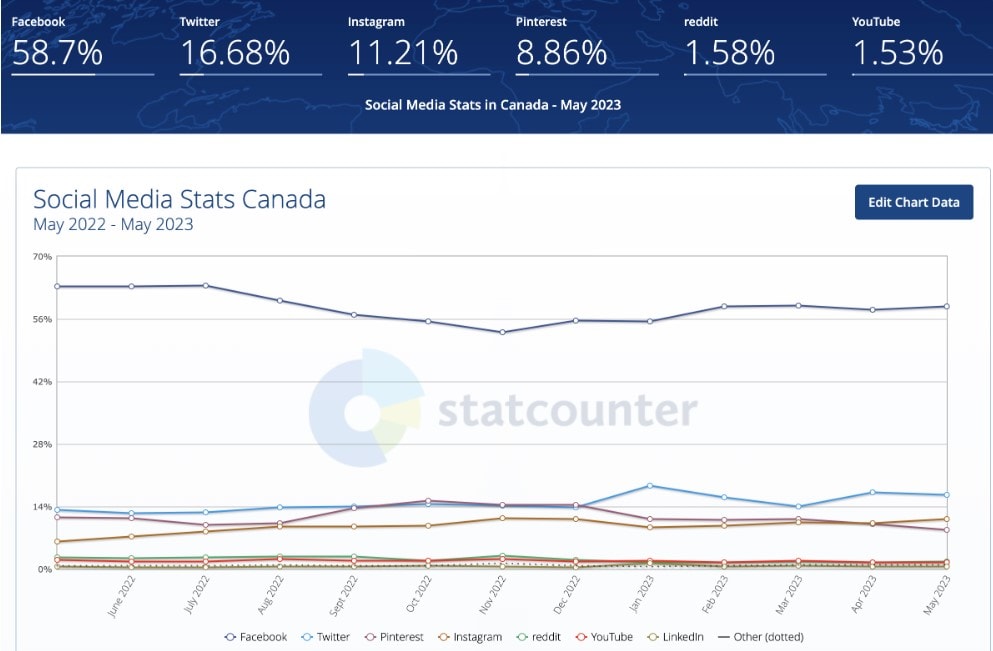
According to Statcounter, Facebook and Instagram hold almost 60% of Canada’s social media market share.
The Future of Online News in Canada
The enactment of Canada’s Online News Act, Bill C-18, marks a significant point in the relationship between digital platforms and news businesses. The law addresses imbalances in bargaining power and compensates news outlets for their content. However, the responses from Google and Meta indicate a reluctance from tech giants to adapt to the new regulatory framework, leading to their removal of Canadian news content.
This development raises critical questions about the future of news dissemination through digital platforms in Canada and the evolving dynamics of regulation, technology, and journalism.
The effectiveness and consequences of Bill C-18 will be closely monitored not only in Canada but also in other countries grappling with similar issues.
Featured image: JHVEPhoto/Shutterstock
Google’s Efforts to Improve Bill C-18
Google has been proactive in supporting Canadian journalism through its programs and partnerships and expressed a willingness to do more. As part of its Google News Showcase program, Google has negotiated agreements with over 150 news publications across Canada. Last year alone, Google linked to Canadian news publications more than 3.6 billion times—at no charge—helping publishers generate revenue through ads and new subscriptions. This referral traffic from links is valued at $250 million CAD annually.
Google has made it clear that it is willing to do more, but it cannot do so in a way that breaks the structure of the web and search engines and creates untenable product and financial uncertainty.
Ever since the introduction of C-18, Google has shared its experiences in other countries and made it clear that unworkable legislation could lead to changes affecting the availability of news on Google’s products in Canada.
Google has successfully collaborated with governments and news publishers around the world on the shared goal of strengthening the news industry. It currently has thousands of mutually beneficial agreements with news publications around the world.
Google’s Attempts to Amend Bill C-18
Google tried to apply the same collaborative approach to Bill C-18. The tech giant offered constructive feedback and recommended solutions that would have made the bill more workable for both platforms and publishers, unlocking further financial support for Canadian journalism. Google endorsed the alternative model of an independent fund for Canadian journalism, supported by both platforms and the government—an approach that has proven successful elsewhere.
Google appeared several times before the Standing Committee on Canadian Heritage and the Senate Committee on Transport and Communications and submitted detailed recommendations to both committees.
Google advocated for reasonable and balanced amendments to the legislation for over a year, but none of its suggested changes to C-18 were accepted.
Google’s Ongoing Dialogue with the Canadian Government
Despite the passage of Bill C-18, dialogue between Google and the Canadian Government continues. Just last week, as the Bill was approaching its final passage and Royal Assent, the Government agreed to discuss the possibility of addressing some of the most critical issues, which Google welcomed.
In that discussion, Google sought clarity on financial expectations platforms face for merely linking to news, as well as a specific, viable path towards exemption based on their programs to support news and commercial agreements with publishers.
While Google appreciates the Government’s acknowledgement that their concerns were reasonable and confirmation that the law will not apply until they adopt implementing regulations, they have not provided Google with sufficient certainty that the regulatory process will be able to resolve structural issues with the legislation (such as forced payment for links and uncapped financial liability).
Impact of Google and Meta’s Decisions on Canadian News
Google announced that it would stop showing links to Canadian news on its products in Canada after the passage of the Online News Act, which requires online platforms to pay content fees to Canadian news outlets. This decision follows Meta’s announcement that it would remove Canadian news from Instagram and Facebook.
Google and Meta have pushed back against the Online News Act, soon to become law, which was designed to assist struggling news outlets in getting better compensation from Big Tech.
Google criticized the law, calling it “unworkable” and “the wrong approach to supporting journalism in Canada.” Google will also end its Google News Showcase program in Canada, which pays news publishers to curate news stories on Google platforms.
“We’re disappointed it has come to this. We don’t take this decision or its impacts lightly and believe it’s important to be transparent with Canadian publishers and our users as early as possible,” Google stated.
Google asserted that it helps news publishers generate revenue through ads and new subscriptions resulting from exposure on Google platforms.
Lawmakers introduced the act, known as Bill C-18, in response to the rapid decline of local newsrooms in Canada in recent years, when Big Tech profited off online advertising revenues, according to the Ministry of Canadian Heritage.
“We want to make sure that the news media and journalists are fairly compensated for their work,” Canadian Heritage Minister Pablo Rodriguez, the bill’s sponsor, said in a statement last year.
Global Repercussions of Google and Meta’s Decisions
Canada’s bill was modeled on a law in Australia, introduced in 2021, that pushed Google and Meta to pay content fees to Australian news publications.
Initially, Facebook removed sharing and viewing of local and international news in Australia, but it restored news access a few days later after negotiations with the Australian government.
In the last three years, several countries have enforced similar regulations requiring tech companies to pay local news organizations for their online content.
In 2021, Google agreed to pay French publications to reuse their content. In 2020, through Google News Showcase, it agreed to pay publications in Germany, Brazil, the U.K., and other countries in a deal worth $1 billion.
Google pulled its news service from Spain in 2014 rather than pay publishers but reinstated Spanish news last year after the country’s copyright laws gave news outlets more agency over monetization.
In the U.S., progress has been slower on efforts to charge Big Tech for news content. Sen. Amy Klobuchar, D-Minn., this month introduced the Journalism Competition and Preservation Act, which had stalled in previous years, through the Judiciary Committee. It would support news publishers in negotiating with tech platforms for content fees.
Meta previously spoke against the act, threatening to remove news from its platforms if Congress passed the bill.
A similar bill was introduced in California in March; it would require social media companies to pay a “journalism usage fee” that includes a percentage of their ad revenue to news publishers.