
Who are the web design visionaries who contributed to the advancement of the industry’s critical thoughts and technologies? In a previous article, we chronicled the evolution of web design since the late 80s, citing important events in its history.
In this piece, we pay homage to the personalities behind those events – pioneers, inventors, computer scientists, and advocates – who introduced and forwarded technologies and innovative thinking that made web design what it is today.
This is part of our article series on web design meant to inform, inspire, and deepen your enthusiasm for this field of discipline. Welcome to another retrospective, this time focusing on individuals and their invaluable contribution to web design.
What Is a Web Design Visionary?
We will not set complex criteria in defining a web design visionary. We’ll go by the root word “visionary” – someone who introduces new concepts and methods. That makes the person an innovator, groundbreaker, or trailblazer. In other words – a leader in web design and its many related fields like the Internet, computing, UX/UI, design tools, etc.
The world of web design was founded on the ideas of these leaders who sought solutions to challenges and issues, from the time the Web was hatched to the present period when web design is focused on providing a compelling experience to website users and where users themselves have become website owners. We are at Web 3.0.
The area of web design is not lacking of forward-looking persons who shared their knowledge for the advancement of the industry. Ironically, many of them are unknown even to those in the design community. Web designers are knowledgeable about HTML, CSS, and JavaScript but some have no idea who created them.
These visionaries have been lauded and acclaimed by prestigious institutions and organizations around the world. Through this article, we add our humble recognition and respect that these esteemed persons so richly deserve. Here’s another journey of information and discovery.
The 1980s
1. Steve Paul Jobs, an American industrial designer, and co-founder of Apple, Inc. was an advocate of simple but useful designs exemplified in the company’s products starting with the Macintosh. It was launched in January 1984 as the first mass-market PC with an integral mouse and graphical user interface. These UIs are still utilized in web design today.
2. Don Norman, an American author, researcher, and professor, introduced the term “user-centered design” in his 1986 book User Centered System Design: New Perspectives on Human-Computer Interaction. His advocacy is that designers should base their designs foremost on the needs of users while other aspects like aesthetics should be secondary considerations.
3. Thomas Knoll, software engineer, and John Knoll, visual effects supervisor at Industrial Light and Magic (ILM). The American brothers were the original creators of Photoshop in 1987. The following year they sold the distribution license to Adobe Systems, Inc. It was first available for the Macintosh in 1990 and then on Windows in 1993.

Tim Berners-Lee, creator of HTML and the Web. Image credit: engramme-blog.blogspot.com
4. Tim Berners Lee, An English computer scientist and engineer, wrote a proposal in March 1989 that eventually led to the creation of the World Wide Web which became the framework for the Internet. He created HTML and the first website, site URL, web page, web server, web browser, and posted the first photo on the web. He is regarded as the forefather of web design.
The 1990s
5. Alan Emtage is a Barbadian-Canadian computer scientist who wrote in 1990 the original implementation of Archie, regarded as the first Internet search engine. He was then a postgraduate student at McGill University in Montreal. Archie was designed to index FTP archives so users can easily identify and search for specific files.

Håkon Wium Lie, the inventor of CSS. Image credit: code.arnoldbodeschule.de
6. Håkon Wium Lie, Norwegian web pioneer. He created the Cascading Style Sheets (CSS) in 1994 and worked on its specifications for some years with contributions from Bert Ross. The new coding language allowed for changeable colors, fonts, and layouts, giving site owners better control over website design and appearance.
7. Marc Andreessen, a software engineer, and Eric Bina, a software programmer, created the Mosaic browser, launched in 1993 for Macs and PCs. It was the first widely available browser and considered the first graphical web browser capable of displaying images and text together, and not in separate windows.
8. Matthew Gray, a software engineer who developed one of the very first search engines – the World Wide Web Wanderer – in 1993 when he was at MIT. Also called The Wanderer, it was a web crawler that generated an index named The Wandex, considered the first bot-powered search engine.
9. James Henry Clark, a computer scientist, would team up with Marc Andreessen to establish Netscape in 1994. It was the first company to capitalize on the emergent World Wide Web releasing its first product, the Mosaic Netscape 0.9, which became popular at that time and was rebranded the Netscape Navigator.
10. David Bohnett, a technology entrepreneur, together with John Rezner founded Geocities in 1994. It was one of the earliest web hosting services and one of the first social networking platforms, the predecessor of MySpace and Facebook.

Brendan Eich, creator of JavaScript. Image credit: dashbouquet.com
11. Brendan Eich, an American computer programmer, came up with the JavaScript programming language while working at Netscape. JS would become a cornerstone technology of the Web together with HTML and CSS. Eich later took on various tech executive roles including CTO then CEO of Mozilla Corporation, and CEO of Brave Software.
12. Charlie Jackson, Jonathan Gay, and Michelle Welsh are software entrepreneurs who founded FutureWave Software in 1993. Its first product was SmartSketch, a pen drawing program later modified into the FutureSplash Animator. FutureWave was bought by Macromedia in 1998 and rebranded the animation editor as Macromedia Flash. It would become a dominant web design tool in the mid-90s, enabling “rich websites” to carry animation, audio, high-quality images, and interactivity. Adobe acquired Macromedia in 2005 and renamed the tool Adobe Flash.
13. Jakob Nielsen is a Danish researcher dubbed the “guru of Web page usability” by the New York Times in 1998. His studies centered on web usability and the budding field of user experience design (UX) which were expounded in his book Designing Web Usability: The Practice of Simplicity published in 1999. He went on to form the Nielson Norman Group with another prominent usability expert Don Norman. Nielson would come up with 10 heuristics considered as the benchmark for UI design. These are:
- Visibility of system status
- Match between the system and real world
- User control and freedom
- Consistency and standards
- Error prevention
- Recognition rather than recall
- Flexibility and efficiency of use
- Aesthetic and minimalist design
- Help users diagnose, recognize, and recover from errors
- Help and documentation
14. Evan Williams and Meg Hourihan founded Pyra Labs in 1999 whose first app was a combination to-do list, contact manager, and project manager. The app was modified by the company’s coder Jack Dorsey that allowed online users to upload a web log. Pyra was repurposed into Blogger which was acquired by Google in 2003. Blogger.com would popularize the blogging website platform. Williams and Dorsey would later form Twitter.
15. Darcy DiNucci, a web designer and UX expert, coined the term Web 2.0 in a 1999 article. Also known as social web or participative web, it refers to websites that are easy to use and had user-generated content like photo-sharing sites and online forums. The term was later popularized by authors Tim O’Reilly and Dale Dougherty during the first Web 2.0 Conference in 2004. The term is an upgrade of Web 1.0, the era of read-only websites (1990-2000), where users had no site participation or interaction.
The 2000s
16. Steve Krug published his book Don’t Make Me Think in 2000, dealing with web usability and human-computer interaction. He supports the belief that a website or software should allow users to complete their intended tasks as directly and easily as possible. The book is on its third edition, has sold over 300,000 printed copies, and is a reference for college and online courses on usability.
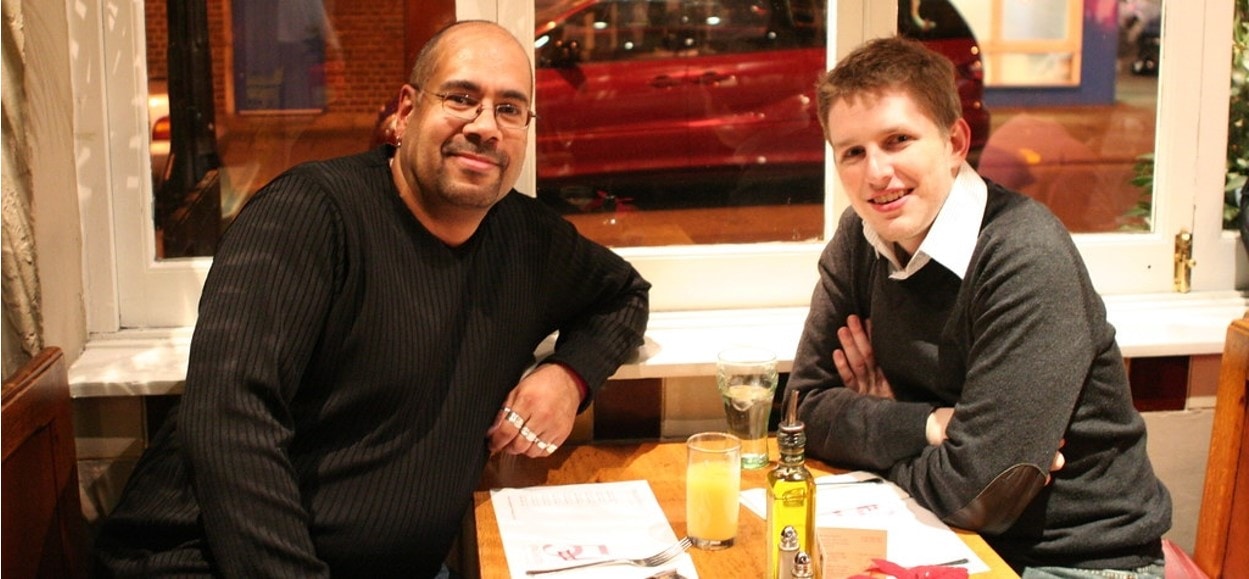
Mike Little and Matt Mulleweg, creators of WordPress. Image credit: flickr.com
17. Matt Mulleweg and Mike Little, both web developers, released WordPress in 2003. It was originally designed as a blog-publishing system but evolved to become a content management system. As of 2021, WP is used by over 42% of the top ten million websites.
18. Jeffrey Zeldman, a web designer and entrepreneur, comes out with the book Designing with Web Standards in 2003. A proponent of standards-compliant web design, Zeldman explains in his book (targeted at web development professionals) how to properly implement web standards to create user-friendly and accessible websites. Over 85 colleges use the publication as a textbook.
19. Stewart Butterfield, a web designer and businessman, and Caterina Fake, an entrepreneur, founded Ludicorp in 2004. Its online game was not a success so the company shifted to offering a website called FlickrLive, essentially a chat room with real-time photo-sharing features. It eventually evolved into Flickr and was purchased by Yahoo in 2005. Flickr is a prime example of a Web 2.0 website.
The 2010s

Ethan Marcotte introduced “responsive web design” that leverages the flexibility of the Web to design across different devices. Image credit: designingforuncertainty.com
20. Ethan Marcotte, a web designer, introduced the term “responsive web design” in a 2010 essay and published a book about it the following year. He presented innovative ways of designing HTML documents that optimized the display of website content based on a device’s screen size or resolution.
21. Mark Otto and Jacob Thornton, both working at Twitter in 2011, developed Bootstrap (originally named Twitter Blueprint), an open-source CSS framework for mobile-first, responsive, front-end development. It has been in continuous upgrade and its latest version, Bootstrap 5, was released in 2021. Currently, over 19% of all websites use Bootstrap.
22. Jordan Walke, a software engineer at Meta, came up with the early prototype of the React JavaScript Library (or simply ReactJS) which would become a free, open-source library for building UI components and interfaces. It saw its first deployment in 2011 on Facebook’s News Feed and then in 2012 on Instagram.
23. Alex Vazquez and Tim Sabat, full-stack developers, and Chris Coyier, a front-end designer, founded CodePen in 2012. It is an online community dedicated to showcasing and testing JavaScript, CSS, and HTML code snippets created by developers. The site also serves as an open-source learning platform and online code editor. It is estimated to have a membership of more than 300,000 web developers and designers.
24. Matias Duarte is a computer interface designer and VP of Design at Google. He supervised Google’s Material Design, first introduced in 2014. It is a new visual style and design language characterized by responsive transitions and animations, padding, grid-based layouts, and depth effects like shadows and lighting. It has been gradually rolled out across Google’s mobile and web products.
25. Jonathan Ive is best known as an industrial designer, noted for his contributions when he served as Apple’s chief design officer. Many in the design community take inspiration from the simple but effective design of Apple products which were born from Ive’s adherence to minimalism, such as user interfaces that include only what is needed. Web design have been influenced by trends and practices in print, graphics, industrial and other design fields that have long been in place before the Web was born.
Design Trailblazers of Tomorrow
What we presented is a continuing list. It is a work in progress because advancements in the Web and web design are still unfolding, thanks to the people above and many others who march to the forward momentum of technology.
For sure there will be several other trailblazers for tomorrow. Many of them are already sharing their knowledge and brilliance today. You might have come across their names and their work or even attended their presentations since they are some of the most sought-after speakers at design conferences.
Among the current crop of web design luminaries are Vitaly Friedman, David Leggett, Adelle Charles, Cameron Moll, Dave Shea, Dan Cederholm, Karen McGrane, Collis Ta’eed, Matt Mickiewicz, Jacob, Gube, David Airey, Fabio Sasso, Veerie Pieters, and many more.
It is common to say that the rapid development of web design is because of technology. But many overlook that technology is the product of people – pacesetters eager to introduce new solutions or work to upgrade the foundation that has already been laid since the 80s. We eagerly look forward to more innovations from more of these visionaries.
Check out this complete guide about web design.